


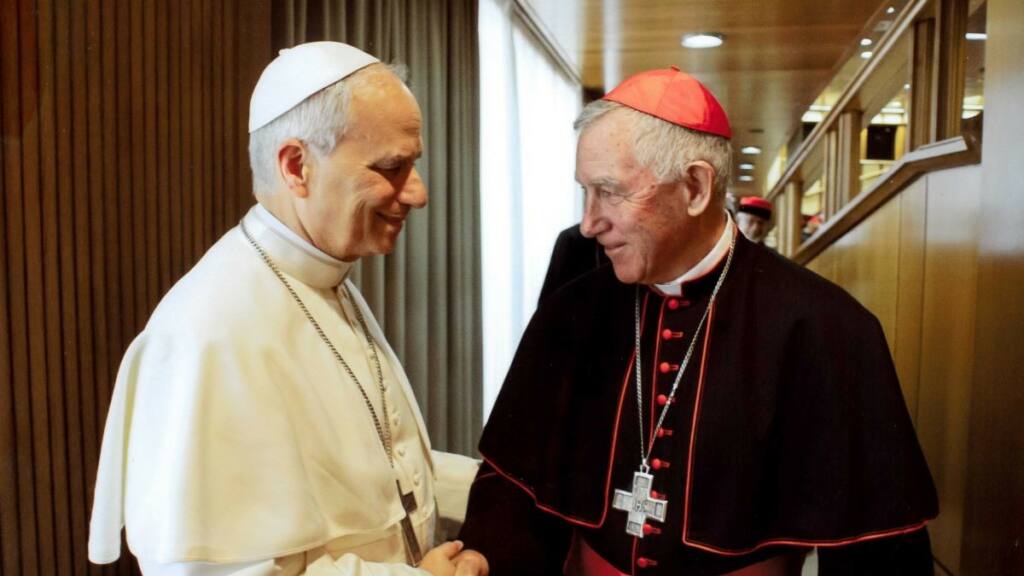
By Cardinal John Dew
Not long after the Conclave in May last year, Cardinal Vincent Nichols of Westminster was interviewed. When the reporter asked him the question “Why did the Cardinals choose Cardinal Prevost?” the answer he gave was “We did not choose him, God chose him, we just found him.” His words appealed to me. Of course, God chooses any of us for a particular task (or vocation) in life.
I believe we found the right man to succeed Pope Francis and to assume the role of Bishop of Rome. In that process of “finding” him we had several days of meetings. In those meeting we had the opportunity to reflect together on what the major issues were in the Church and the world today, we also naturally spoke of the kind of person and the gifts and talents he would need to lead the Church in the modern world. Pope Leo was who we found, and that finding was the work of the Holy Spirit.
A topic that arose many time during those meeting was that whoever the next Pope was it would be helpful, and even necessary to meet more frequently with the College of Cardinals. Pope Leo obviously heard those words (he is a very good listener), he heard the words and called for a Consistory (meeting) of Cardinals in early January. He also told us that he will invite us to go back to Rome again in June of this year.
Not long before Christmas we were given the agenda for the Consistory and told that it would be helpful to read “Evangelii Gaudium,” the first Apostolic Exhortation of Pope Francis (24 November 2013) which is about the Church’s missionary character. The second document to read was the Apostolic Constitution Praedicate Evangelium, on the role of the Roman Curia and its relationship with the particular Churches around the world. The other topics to be considered were Synodality and Liturgy, we were asked to read up on those topics.
On January 6, the Feast of the Epiphany, we were privileged to be present when Pope Leo closed the Holy Year and officially closed the Holy Door of St Peter’s, which will not be opened until the next Year of Jubilee. In one part of his homily, he said:
“The Holy Door of this Basilica, which today is the last to be closed, has seen a stream of innumerable men and women, pilgrims of hope, journeying toward the new Jerusalem, the city whose doors are always open (cf. Rev 21:25). Who were these men and women, and what motivated them? At the end of this Jubilee year, the spiritual searching of our contemporaries, much richer than perhaps we can comprehend, invites us to earnest reflection. Millions of them crossed the threshold of the Church. What did they find? What was in their hearts, their questions, their feelings? Yes, the Magi still exist today. They are the people who sense the need to go out and search, accepting the risks associated with their journey, especially in a troubled world like ours that may be unpleasant and dangerous in many ways.”
Aware that we were going to begin the Consistory the next day I felt that we too were like the Magi, spiritually searching ourselves and wondering how we could assist the Holy Father. He was very clear in telling us when we gathered that he wanted to foster shared discernment and that he was looking to us for support and counsel as he carries out his responsibility for the governance of the universal Church. That is a big ask of any of us!
The actual meeting was short – it was only two days, but they were two days well spent, and it was the first time I had been involved in Rome in using the synodal process and engaging in the “Conversations in the Spirit” process. It was powerful, respectful and obviously cantered in prayer.
As I have said above, four topics had been signalled as possible topics. It was acknowledged at the very first part of the gathering that it was impossible to do justice to the four topics, and that we would need to decide together what two topics we would address. To do that we engaged in the Synodal process and decided that those topics would be Synodality and Evangelii Gaudium.
At those meetings before the Conclave last year, the question of Synodality had been spoken of often. There was a plea from many that the Synod process needed to be continued in the Church of today. Pope Leo referred to that in his words at the opening session of this Consistory, “we embrace the Synod and synodality as both an instrument and a style of cooperation.” He did not in any way influence the gathering as to the topics to be discussed, but it was clear that he wanted to hear from the College of Cardinals. In fact, he said “I am here to listen,” he also said a couple of times “You elected me to this position, now you need to help me.”
I was personally thrilled to know that Synodality had come though very clearly as a topic to be addressed, this signalled to me that there is a new approach to decision-making, to sharing and listening, and that it is very much directed by the Holy Spirit. I was aware of the words of Pope Francis saying that what he wanted was, “A church sensitive to the least breath of the Holy Spirit, a Church that was open to being led by the unpredictability of grace.”
This meeting was very positive, and gave me the assurance that if we are to be sensitive “to the least breath of the Holy Spirit,” then listening is essential. I witnessed a Pope who listens intently, and I experienced the College of Cardinals listening to one another in a whole new way. Synodality is clearly on the agenda for the Church today.
The second topic we decided to spend time on was not just the Exhortation of Pope Francis Evangelli Gaudium but the whole question of making the Gospel known. Pope Francis began Evangelii Gaudium with the words “on the proclamation of the Gospel in today’s world.” This became our theme as we explored this topic and the urgency for the world to hear the Gospel.
A line I remember from someone in our group was, “The demise of Pope Francis does not mean the demise of Evangelii Gaudium, in fact in today’s confused and troubled world it is more urgent than ever.” I found it interesting and very positive that everyone was agreed on and saw the urgency of making the Gospel known today.
The Holy Father’s words in that first session set the scene as he connected our meeting with the Feast of the Epiphany the day before, he said: “I consider it highly significant that we have gathered in Consistory on the day after the Solemnity of the Epiphany of the Lord, and I would like to introduce our work by proposing something drawn precisely from this mystery.
The liturgy echoed the ever-moving appeal of the prophet Isaiah: “Arise, shine; for your light has come, and the glory of the Lord has risen upon you. For darkness shall cover the earth, and thick darkness the peoples; but the Lord will arise upon you, and his glory will appear over you. Nations shall come to your light, and kings to the brightness of your dawn” (Is 60:1-3).
I was very conscious that while we were praying and reflecting we were very aware of “the darkness that covers the world today,” the conflicts and wars, poverty, effects of climate change, the disparity between the rich and the very poor; and we were all convinced that the world needs to hear and experience the Good News of the Gospel.
We decided on Synodality and Evangelii Gaudium, but that did not in any way lessen the importance of the Liturgy or of Predicate Evangelium. It just seemed that it was more urgent, with the time we had for us to pray about and discuss Synodality and preaching the Gospel. We acknowledged that we have many Liturgical documents and that there is always a need to continue to educate the People of God on what liturgy actually is. We also had a Consistory on Predicate Evangelium in Rome in October 2022, which I attended. We were aware of that Consistory and therefore decided that topic could wait for another time. I actually believe that the service the Roman Curia offers has changed dramatically for the better since that meeting in 2022.
I want to conclude this reflection on our meeting with some further words from Pope Leo’s talk of the first day of our gathering.
He spoke of the Second Vatican Council, and said: “this conciliar perspective, which sees the mystery of the Church as entirely held within the mystery of Christ, and thus understands the evangelizing mission as a radiation of the inexhaustible energy released by the central event of salvation history.
Popes Benedict XVI and Francis, in turn, summarized this vision in one word: “attraction.” Pope Benedict referred to this in his homily for the opening of the Aparecida Conference in 2007, when he said: “The Church does not engage in proselytism. Instead, she grows by ‘attraction’
“The question for each one of us is: “What do we do and how do we live in such a way to attract others to Jesus Christ who is the Way, the truth and the Life.”
I think it is important for us to be aware of the impromptu words of Pope Leo at the conclusion of the first session. His words tell us something of who he is and how he sees his role as Bishop of Rome.
“Good evening again, and many thanks for all the work already done in this first session.
“I would like to start just by repeating the words of one of the secretaries, the first to speak, who suggested that the journey has been as important as the conclusion of the work at the table. I would like to start from there to say, first of all, thank you for being here! I think it is very important that you are all participating in this experience as the College of Cardinals of the Church, which offers not only to us – it is not for us – offers to the Church and the world a certain testimony of will, of desire, recognizing the value of being together, of making the sacrifice of a journey – for some of you, very long – to come to stay together and to be able to seek together what the Holy Spirit wants for the Church today and tomorrow. So for this reason, I truly think it is important, even if it is a very short time, but it is a very important time for me too, because I feel, I experience the need to be able to count on you: it is you who have called this servant to this mission! So, I would like to say that I think it is important that we work together, that we discern together, that we seek what the Spirit is asking of us.”
This Consistory for me was a wonderful experience, an experience of gathering in prayer, listening to one another with respect and knowing that “Conversations in the Spirit” really do work.